April 8, 2026 - Finding out how much water goes where in the Brazos River Authority Water Supply System is as simple as, well, checking out this graphic.
The Brazos River Authority just released its 2025 Customer Water Use and Reservoir Accounting Summary, which is basically a super user-friendly graphic that breaks down all the water data. All water used in the BRA’s Water Supply System is accounted for, including, how much water is used, by whom, and where, among other details.
The BRA’s Water Supply System is made up of 11 reservoirs scattered across the huge more than 42,000-square-mile river basin. Three of the reservoirs were built and are owned and operated by the BRA: lakes Possum Kingdom, Granbury, and Limestone. The other eight — Proctor, Whitney, Aquilla, Belton, Stillhouse Hollow, Georgetown, Granger, and Somerville — are owned and operated by the U.S. Army Corps of Engineers. The BRA contracts with the federal government to store water in these multi-use reservoirs.
Interesting side note, the BRA is not the only entity that has water rights in the basin. It’s just the largest provider of wholesale surface water within the basin.
The BRA holds 17 water rights in the Brazos River Basin. There are more than 1,900 state-issued water rights in the Brazos River Basin held by individuals, farmers, cities, corporations, and the largest petrochemical company in the Northern Hemisphere, Dow Chemical. (Learn more about what a water right is here.)
Under the 17 state-issued water right permits, the BRA is responsible for distributing water to municipalities, industry, agriculture, and mining within the Brazos basin. Those who use the water include cities, water districts, water supply corporations, agricultural users, irrigators, manufacturing entities, steam electric generating facilities, and mining operations.
The Customer Water Use and Reservoir Accounting Summary details each reservoir, including inflows (water flowing into the lake from the river), water released for water supply, water used by lakeside users, and water lost to evaporation, among other factors. Totals are measured in acre-feet, which is the amount of water needed to cover one acre (43,560 square feet) with one foot of water. One acre-foot equals 325,851 gallons of water.
In 2025, 328,698 acre-feet of water was used across the basin. The breakdown of that total includes roughly:
- 48% of the water going to municipal purposes,
- 45% to industrial uses such as electric generation,
- 5% to irrigation, and
- 2% to mining.
Meanwhile, evaporation was once again the largest consumer of water in the basin last year. Evaporation consumed 515,156 acre-feet of water during the calendar year, basically making it the biggest “user” of water throughout the Brazos River Basin. (Learn more about evaporation and the water cycle).
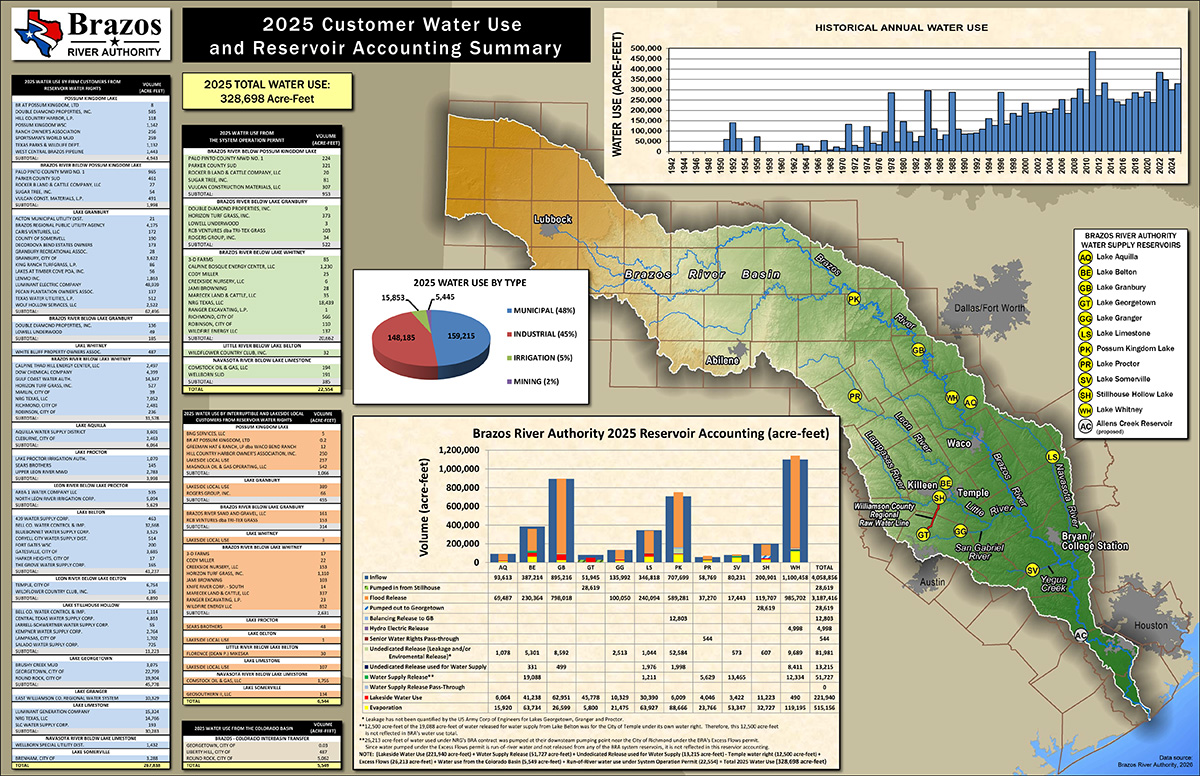
The report also details how much floodwater was released per reservoir. The three BRA reservoirs have no flood storage; therefore, when these lakes are full, water must be passed downstream to protect the integrity of the dam. In 2025,
- Possum Kingdom Lake released 589,281 acre-feet, an amount that is larger than the complete capacity of the reservoir;
- Lake Granbury released 798,018 acre-feet, an amount that refilled the reservoir nearly six times over, and
- Lake Limestone released 240,094 acre-feet of flood water, an amount larger than the entire capacity of the reservoir.
There wasn’t much change between the 2024 and 2025 Customer Water Use and Reservoir Accounting Summary, said BRA Hydrologist Donald Hood. Water use increased by about 30,000 acre feet, just a mere 10% more than in 2024. That 10% didn’t come from a single location but was widely distributed across the basin.
The biggest difference is that there was about a 54% increase in the use of interruptible water between 2024 and 2025.
In 2024, about 4,253 acre feet was used as interruptible water, and in 2025, it totaled 6,544 acre feet.
Interruptible Water is water available in storage that was not used in previous years, Hood said. If there’s a rainy year, chances are good there’ll be some interruptible water available the next year. These contracts only last a year, and they can be cut off if there’s a water shortage; hence, the name. Each year, the BRA’s Board of Directors decides how much, if any, interruptible water can be offered for the next calendar year.
For example, there wasn’t any interruptible water in 2023 because of the drought in 2022. But in 2022, about 56,700 acre-feet were available, thanks to all the extra rain in 2021.
For more information on the BRA’s Customer Water Use and Reservoir Accounting Summary or to see past year’s reservoir accounting summaries, go here.
Total water use by municipal, industrial, irrigation, and mining in the BRA System over previous years:
- 328,698 acre-feet in 2025
- 300,973 acre-feet in 2024
- 351,417 acre-feet in 2023
- 325,879 acre-feet in 2022
- 238,896 acre-feet in 2021
- 288,968 acre-feet in 2020
- 264,454 acre-feet in 2019
- 284,268 acre-feet in 2018
- 252,987 acre-feet in 2017
- 226,348 acre-feet in 2016
- 242,721 acre-feet in 2015
- 255,946 acre-feet in 2014
Total amount lost to evaporation in the BRA System over previous years:
- 515,156 acre-feet in 2025
- 525,028 acre-feet in 2024
- 474,965 acre-feet in 2023
- 502,050 acre-feet in 2022
- 506,756 acre-feet in 2021
- 540,244 acre-feet in 2020
- 458,071 acre-feet in 2019
- 470,120 acre-feet in 2018
- 494,061 acre-feet in 2017
- 535,326 acre-feet in 2016
- 479,294 acre-feet in 2015
- 411,633 acre-feet in 2014